Fritz Mandl
The Glass RoomFritz Mandl is a Viennese businessman and head of Hirtenberger Patronen-Fabrik whose proposed arms-industry partnership brings him into the Landauers’ Glass Room. His visit also exposes the private violence behind his polished public presence: he treats his wife, Eva Mandl, as someone to control, not as a person free to pursue her own ambitions. Through the contrast between the room’s ideal of rational order and Mandl’s possessiveness, his brief appearance reveals how power can turn beauty, marriage, and even a modern domestic space into instruments of confinement.
Businessman and Prospective Partner
Mandl arrives with a commercial proposal for Landauerovy Zádovy, the Landauer company. He and Viktor Landauer have already met a couple of times to discuss a joint venture in the rapidly expanding market for military equipment. Mandl presses the urgency of the opportunity: he says German and Italian demand is growing, armoured cars are the latest development, and the company should move before a competitor does. His contacts and projects make him a plausible partner, linking the Landauers’ business to the arms trade at a moment when military markets are expanding.
At the gathering in the Glass Room, Viktor greets Mandl, but the narrative attention shifts to Eva. The room’s gleaming chrome surfaces multiply her reflection, while her quiet, nervous manner unsettles the image of effortless glamour. She compliments the modern house, and Mandl’s presence initially carries the authority of a successful businessman; what follows makes clear that his influence reaches far beyond commercial negotiation.
Control of Eva Mandl
After the guests have left, Hana tells Viktor what Eva has disclosed. Mandl has bought every print of the film in which his wife appeared and destroyed them. He refuses to let her return to acting and keeps her under guard around the clock, leaving her virtually a prisoner. Eva has tried to escape before: in Paris she made a run for it, but Mandl’s people followed and dragged her back to their hotel. Her wish to resume her film career and her efforts to get away stand in direct opposition to the control he exerts over her.
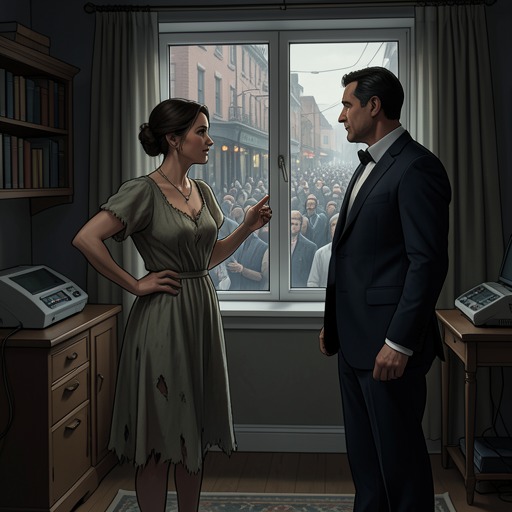
Mandl’s behaviour also surfaces in the conversation about Eva’s appearance in the film Ekstase. When Hana praises Eva’s performance, Mandl insists that the subject is not to be discussed. He calls her a foolish child and frames her past work as a mistake, speaking as though he can decide which parts of her life may be acknowledged. His anger is restrained but unmistakable: his face tightens and the area around his nose whitens. He then describes the film as a misjudgement and again insists that Eva does not wish to discuss it. The exchange shows him attempting to close down not only her career but also other people’s recognition of it.
Conflict and Narrative Significance
Hana rejects Mandl’s attempt to dictate the conversation, affirming the beauty and innocence she sees in Eva’s performance. The disagreement exposes a conflict over who has the right to define Eva: Mandl presents her as a foolish girl whose past should be suppressed, while Hana speaks to her as a woman with ambitions, desires, and dreams. Hana’s sympathy is not merely aesthetic admiration; she understands that Eva is desperate to escape a life in which her husband controls both her movement and her public identity.
Mandl’s episode gives the Glass Room’s polished modernity a sharp counterpoint. The room initially impresses visitors with its abstraction and apparent order, yet within it a woman’s freedom is tightly circumscribed by her husband’s money, surveillance, and authority. Mandl appears as a prospective partner in a business venture, but his treatment of Eva makes his power more intimate and coercive than his commercial pitch first suggests. His role in the novel is therefore brief but revealing: he brings the expanding arms market into the Landauers’ social world while embodying the private domination concealed beneath respectable wealth.